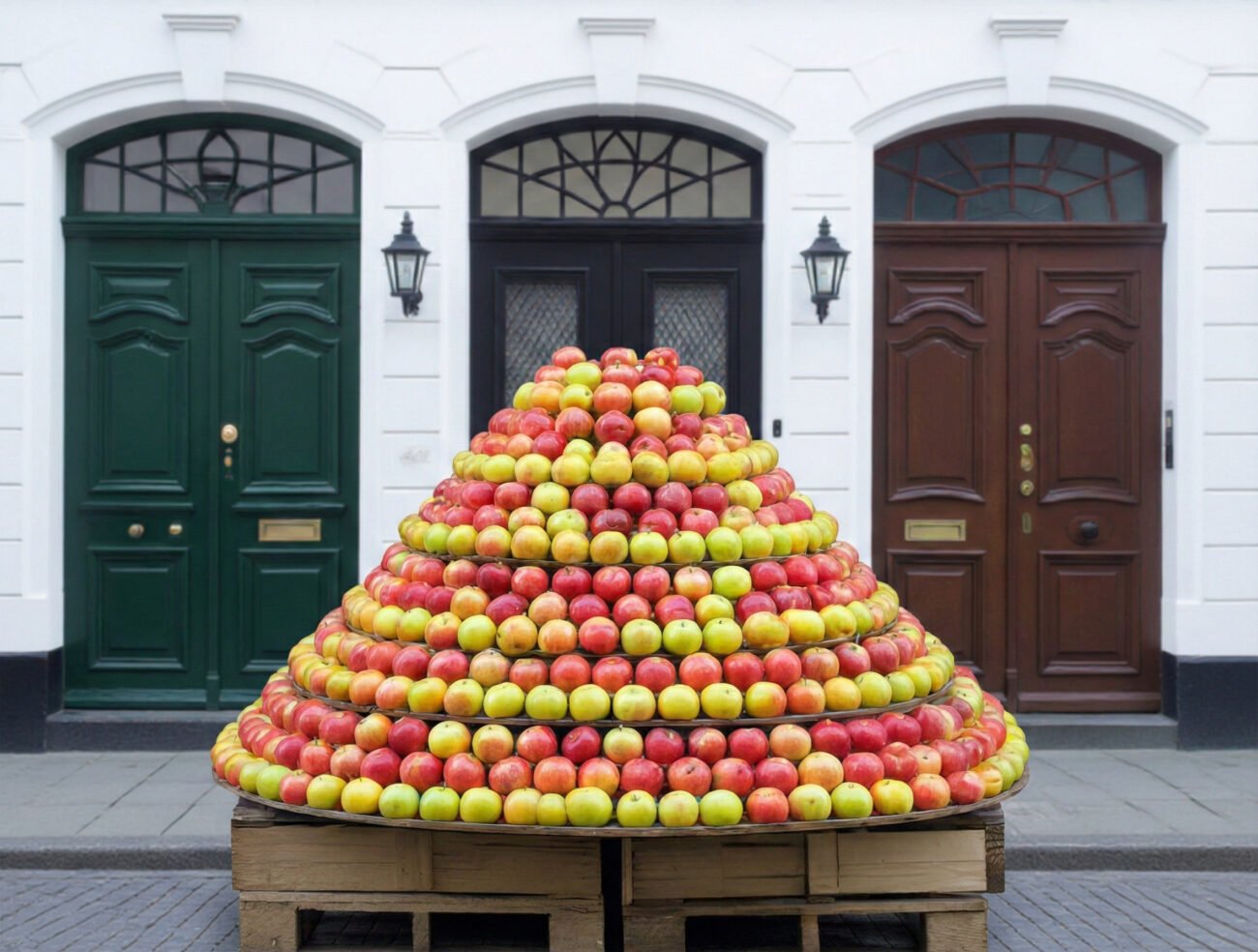
Imagine standing at the edge of a vast orchard in late autumn. Every tree is heavy with fruit, branches bending under the weight of perfect apples, pears, plums, and varieties you have never even tasted. You can pick anything. You can pick everything. And yet, something strange happens as you stand there surveying row after endless row: you find yourself unable to reach for a single piece of fruit. The abundance itself has become the obstacle.
This is the peculiar paralysis of our age. We have more options for how to live, whom to love, where to work, what to consume, and who to become than any generation in human history. And rather than making us feel liberated, this avalanche of possibility is quietly suffocating something essential in us: the capacity to choose with confidence, commit with depth, and find genuine satisfaction in the life we are actually living.
The phrase spoiled for choice deserves closer examination, because the word spoiled is doing far more work than we usually give it credit for. Something spoiled has been ruined by excess. Fruit spoils when it receives too much moisture, too much warmth, too much of what would otherwise nourish it. A child is called spoiled when they receive so much that they lose the ability to appreciate any of it. The phrase, taken seriously, contains a warning: abundance, left unchecked, corrodes the very faculty it was meant to serve.
The Psychology of Too Many Doors
Psychologist Barry Schwartz spent years studying what happens to people when their options multiply. What he found was counterintuitive and deeply revealing. As the number of choices available to a person increases, satisfaction with any particular choice tends to decrease. The more alternatives you can imagine, the more you second-guess the path you took. Every option not chosen becomes a ghost that haunts the option you did choose, whispering that perhaps something better was waiting behind another door.
This phenomenon runs deeper than mere indecisiveness. It reshapes how we experience our own lives. When you commit to one apartment, one career path, one partner, one city, you are simultaneously closing thousands of other doors. In a world with relatively few doors, that closing feels natural, even unremarkable. In a world with thousands of doors, all of them brightly lit and beckoning, every commitment starts to feel like a small death. And so we develop strategies for avoiding commitment altogether, keeping our options perpetually open, hovering in a state of eternal almost-choosing.
Research in cognitive psychology suggests that this state of chronic deliberation is genuinely exhausting. Decision fatigue is not a metaphor. The mental energy required to evaluate, compare, and rank options draws from the same limited reserves we need for self-regulation, creativity, and emotional presence. When you spend your morning scrolling through forty-seven breakfast options on a delivery app, you arrive at your workday with a mind that has already run a quiet marathon. And you may not even notice what has been depleted.
The Philosopher’s Warning
Long before algorithms and dating apps, philosophers understood the dangers of unmoored possibility. The Stoics, particularly Seneca, wrote with striking clarity about the human tendency to chase variety at the expense of depth. In his letters, Seneca observed that those who scatter their attention across many pursuits often arrive at the end of their lives having mastered none of them. The person who reads a hundred books in a year, never finishing any, knows less than the person who reads five books slowly and lets them change the way they see.
Søren Kierkegaard explored this with even more psychological precision. He described what he called the dizziness of freedom: the anxiety that arises not from having no choices but from having too many. When everything is possible, nothing feels solid. Identity becomes liquid. You can reinvent yourself every six months, and while that sounds liberating in theory, in practice it often leaves people feeling untethered, uncertain of who they actually are beneath the constant shapeshifting.
Zen Buddhist traditions offer a complementary perspective. There is a teaching about the value of constraint, the recognition that a river without banks is just a flood. When water has nowhere particular to go, it spreads thin and stagnates. When it flows between firm banks, it gains force, direction, and the power to carve stone. Your attention and your life work the same way.
Where the Spoiling Shows Up Most
Romantic Relationships and the Myth of Someone Better
Perhaps nowhere is the spoiled-for-choice phenomenon more visible, or more painful, than in modern romantic life. The rise of what many now call situationships reveals something important about what happens when the romantic marketplace expands beyond our psychological capacity to navigate it. A situationship is, at its core, a relationship where one or both people refuse to commit because they are still quietly auditioning alternatives. The person in front of them is good enough to keep seeing, but not good enough to stop looking.
This creates a peculiar form of emotional suffering. Both people sense the conditional nature of the arrangement. Both feel the absence of full investment, even if neither names it. And over time, the repeated experience of being someone’s option rather than someone’s choice erodes something in both parties: the willingness to be truly vulnerable, the belief that they are worth choosing, the capacity to trust that love can hold.
The deeper psychological pattern here is worth naming clearly. When you have access to thousands of potential partners through a single device in your pocket, a quiet but powerful belief takes root: that commitment is premature until you have seen enough of the field to be confident you are making the optimal choice. The trouble with this logic is that the field never ends. There will always be another profile, another possibility, another person who might be slightly funnier, slightly more attractive, slightly more compatible in some dimension you have decided matters. The search for the perfect partner becomes a way of avoiding the vulnerability required to love an imperfect one.
Attachment theory research illuminates why this pattern is so psychologically costly. Secure attachment, the kind of bond that allows both partners to feel safe enough to grow, requires what psychologists call consistent emotional availability. It needs the signal, spoken or unspoken, that says: I am here, and I am staying. Situationships, by their very structure, withhold that signal. They offer closeness without security, presence without permanence. And over time, they can train both people to associate intimacy with uncertainty rather than with safety.
Career and Purpose
A similar dynamic plays out in professional life. Previous generations often entered a career and stayed, not always by choice, but the constraint itself created a kind of depth. You learned your craft. You built relationships. You developed mastery through repetition and slow refinement. Today, the average young professional is told they can be anything, do anything, pivot at any time. And while that flexibility is genuinely valuable in some ways, it also creates a chronic restlessness that can prevent the deep roots required for meaningful work.
Consider how many people you know who describe themselves as being in a transitional phase, perpetually preparing for the next thing rather than inhabiting the current one. The possibility of a better career, a more fulfilling path, a truer calling always shimmering on the horizon can make the present feel like nothing more than a waiting room. And you cannot do your best work in a waiting room.
There is a name for this in psychology: identity foreclosure is what happens when you settle on an identity too early, but the less-discussed opposite is equally damaging. When you refuse to foreclose on any possibility, when every option remains perpetually live, your sense of self becomes so diffuse that it offers no real guidance. You know what you might want to be, but you have no lived experience of what it feels like to actually be something with your whole heart.
Consumption and the Illusion of Curation
Even in smaller domains, the spoiling effect operates. Streaming services offer tens of thousands of films, and people report spending thirty minutes deciding what to watch before giving up entirely. Social media presents an endless scroll of lifestyles, philosophies, aesthetic choices, and self-improvement frameworks, each one suggesting that your current approach might be inadequate. The sheer volume of information available about how to eat, exercise, meditate, parent, and organize your home creates a background hum of insufficiency that is difficult to silence.
What is lost in all of this browsing is the simple, grounding experience of enjoying something without simultaneously wondering whether you should be enjoying something else instead. The inability to be satisfied with what is in front of you is not a personality flaw. It is the predictable consequence of a nervous system being asked to evaluate more options than it was ever designed to process.
Reclaiming the Capacity to Choose
If the problem is that abundance is eroding your ability to commit, find satisfaction, and live with depth, then the remedy requires something that may feel counterintuitive: the deliberate cultivation of limitation. Not deprivation, and not rigidity, but the thoughtful, voluntary narrowing of your field of vision so that what remains can actually nourish you.
Practice Chosen Constraint
You might begin by noticing where in your life you are keeping the most doors open and asking yourself honestly what that openness is costing you. In romantic relationships, this might mean making a conscious decision to stop browsing alternatives and instead invest fully in the person who has already earned your attention. Not because they are perfect, but because depth is only available to those willing to stay long enough to find it.
In your career, chosen constraint might look like committing to your current work for a defined period, say two years, with the intention of going deep rather than wide. Give yourself permission to stop scanning for the next opportunity and instead pour your intelligence and creativity into the one in front of you. You may discover that the restlessness you attributed to being in the wrong place was actually the discomfort of never fully arriving anywhere.
Develop a Practice of Enough
The word enough has become almost radical in a culture that equates more with better. But developing a felt sense of enough, in your relationships, your possessions, your achievements, your information consumption, is one of the most psychologically grounding practices available to you. Enough is not a ceiling. It is a foundation. It allows you to stand on solid ground rather than forever reaching for the next rung of a ladder that has no top.
You might practice this concretely. When you notice yourself reaching for your phone to browse options you do not need, pause and ask: what am I actually looking for right now? Often the answer is not a better product or a better option but a feeling of security, excitement, or control that no amount of browsing will provide. Naming the real need can help you address it directly rather than through the endless proxy of more choices.
Relearn the Art of Commitment as a Creative Act
Here is something worth sitting with: commitment is not the opposite of freedom. Commitment is what makes freedom meaningful. A musician who commits to the piano for twenty years has more creative freedom than someone who dabbles in twelve instruments for a year each. A writer who commits to a single book for three years creates something that a writer chasing trends every six months never will. The depth that emerges from sustained commitment generates its own kind of abundance, one that is richer and more satisfying than the shallow abundance of infinite options.
This reframe matters enormously for romantic relationships. When you choose one person and invest fully, you are not closing yourself off from possibility. You are creating the conditions for a kind of intimacy and knowing that is only available through sustained presence. You are choosing depth over breadth, and what you find in that depth may surprise you with its richness.
Curate Your Inputs with Intention
Finally, consider how much of your sense of being spoiled for choice is manufactured by systems designed to keep you browsing. Algorithms profit from your indecision. Every minute you spend scrolling, comparing, and deliberating is a minute someone else is monetizing. Recognizing this does not require cynicism, only awareness. You might choose to limit your exposure to platforms that amplify the feeling of inadequacy through endless comparison. You might unsubscribe from newsletters that exist only to show you more options. You might, in a quiet act of rebellion, decide that what you already have is worthy of your full attention.
The Fruit You Actually Pick
Return for a moment to that orchard. The trees are still heavy with fruit, the rows still stretch beyond what you can see. Nothing about the abundance has changed. But something in you can change. You can walk to the nearest tree, reach for the apple that catches your eye, and bite into it with your full attention. You can taste it completely, not as one option among thousands but as this piece of fruit, in this moment, chosen by you.
The sweetness is not diminished by the existence of other fruit. It is only diminished by your refusal to be present with the one you picked.
In a world that will continue to offer you more than you can possibly consume, experience, or explore, the most transformative skill you can develop is the capacity to choose well and then to be fully where you are. Not because the other options were wrong, but because the one you chose deserves the gift of your undivided presence.
The ancient Greek word for happiness, eudaimonia, did not refer to a feeling of pleasure or the thrill of having many options. It pointed toward something more substantial: the deep fulfillment that comes from living well within the life you have chosen. The Stoics understood this. The Zen masters understood this. And somewhere beneath the noise of modern abundance, you understand it too.
You do not need more options. You need more presence with the options you have already chosen. You do not need a bigger orchard. You need the willingness to taste what is in your hand.
That presence is where satisfaction lives. And no amount of scrolling will take you there.