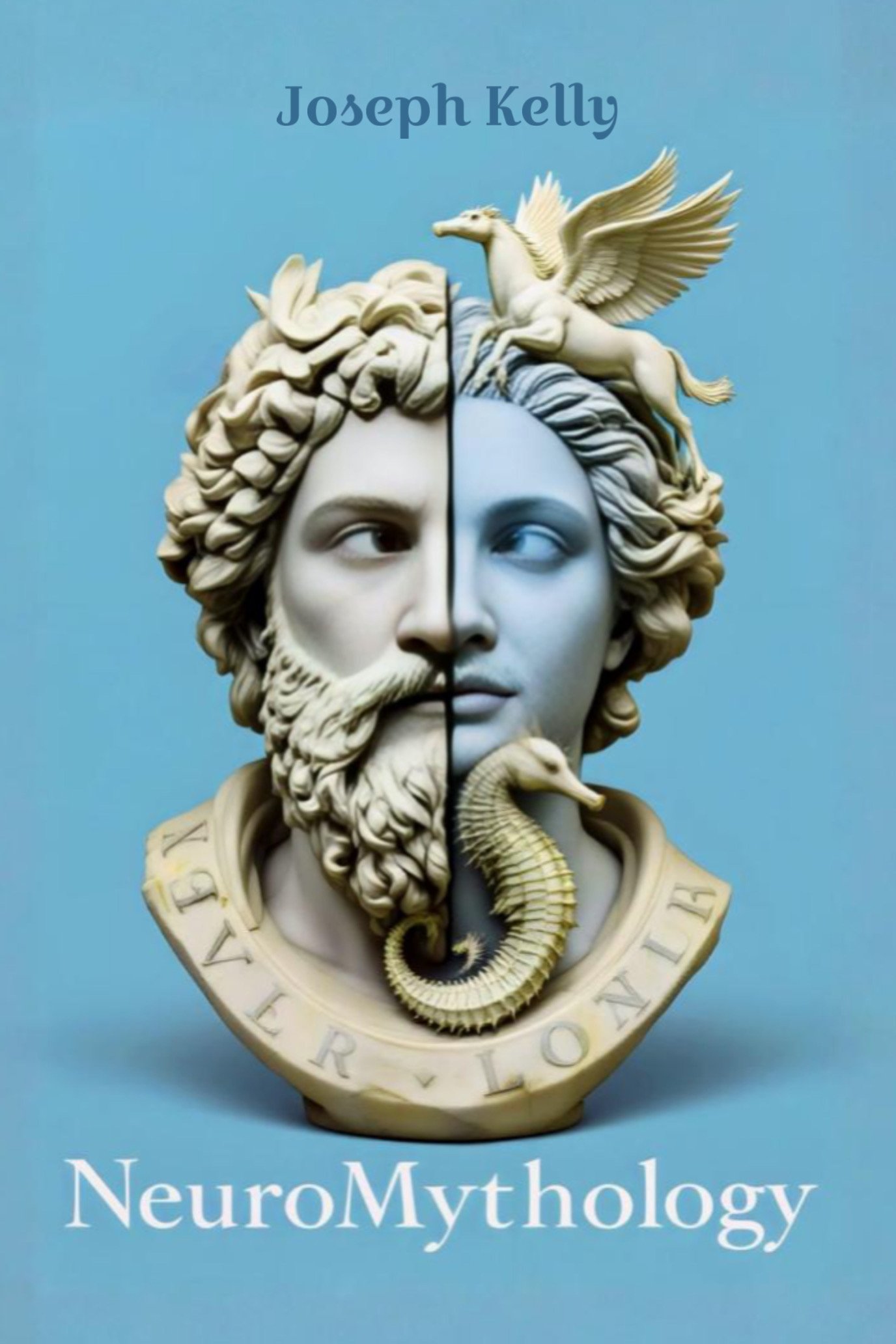
Before you read a single word of this book, you’ve already encountered its central thesis. The cover you’re holding encodes the entire framework we’re about to explore. Let me show you what you’re looking at.
The Split Bust
The sculpture is divided vertically down the center. The left side is white marble, classical and austere. The right side is blue, softer, more contemporary in its coloring. This isn’t aesthetic choice but fundamental principle: you are looking at two aspects of a single consciousness.
The white marble represents what we’ll call the masculine principle throughout this book – not maleness, but a specific mode of consciousness characterized by differentiation, transcendence, boundary-creation, and pattern recognition. It’s the capacity to separate, to distinguish, to individuate. It’s the part of awareness that can step back and observe, that creates distance in order to see clearly, that moves toward abstraction and form.
The blue side represents the feminine principle – not femaleness, but the complementary mode characterized by integration, immanence, relationship, and embodiment. It’s the capacity to connect, to merge, to participate. It’s the part of awareness that joins with what it perceives, that moves toward materialization and communion.
Neither can exist without the other. Neither is superior. They are like the two strands of the DNA double helix, spiraling together to create something neither could create alone. The split bust shows them as aspects of one being because that’s what they are – two movements within a single consciousness, two directions within one developmental journey.
The Color Blue
The choice of blue for the feminine side and for the background carries specific significance that touches the heart of this book’s thesis.
In Greek philosophy, blue corresponds to the element of air. Air represents mind, thought, communication, conceptualization – the realm of cognition itself. But here’s what’s profound: thinking is inherently relational. When you think, you’re creating relationship between concepts. When you communicate, you’re attempting to create shared understanding between separate minds. Cognition is not a solitary act occurring in isolated skulls – it’s fundamentally about connection, about bridging, about creating commons ground between different perspectives.
This is why blue is universally associated with trust, loyalty, credibility, and connection between people. It’s the color of relational consciousness. When witnesses in courtrooms are advised to wear blue, it’s because blue psychologically conveys “I am trying to connect with you truthfully, to create shared understanding.” Blue says: “We are in relationship through communication.”
The blue background of this cover is therefore not decorative. It represents the medium through which consciousness develops and expresses itself – through relationship, through communication, through the constant attempt to understand and be understood. The very act of writing this book, and your act of reading it, occurs within this blue space of relational consciousness.
Pegasus: The Heights
Atop the head, wings spread, sits Pegasus – the winged horse of Greek mythology. Pegasus represents inspiration, the soaring intellect, consciousness at its heights. Born from the blood of Medusa when Perseus beheaded her, Pegasus emerges from the death of what paralyzes and petrifies. He represents the capacity for transcendence, for ascending beyond material limitation, for reaching toward higher understanding.
His placement at the crown of the head is deliberate. This is where consciousness reaches upward, where we access abstract thought, visionary insight, and transpersonal awareness. Pegasus embodies the masculine principle in its fullest expression – the movement toward sky, toward the heavens, toward pure consciousness freed from earthly constraint.
The Seahorse: The Depths
At the throat, positioned exactly at the center of communication, coils a seahorse. This creature belongs to Poseidon, god of the sea, ruler of the emotional and unconscious depths. Where Pegasus soars upward, the seahorse moves through the depths. Where Pegasus represents conscious ascent, the seahorse represents the vast underwater realm of what moves beneath awareness.
The seahorse’s position at the throat is crucial. The throat is the chakra of communication in Eastern traditions, the physical location where internal experience becomes external expression. To speak truthfully, to communicate authentically, requires accessing not just the heights of consciousness (Pegasus) but also the depths (seahorse). Real communication integrates what we consciously understand with what we unconsciously feel.
Interestingly, the seahorse is also one of nature’s examples of reversed reproductive roles – the male carries and births the young. This creature embodies the integration of masculine and feminine principles in unexpected ways, suggesting that the categories we create are always more fluid and interpenetrating than rigid boundaries suggest.
The Inscription
Around the base of the bust runs an inscription, letters that may or may not form coherent words. This ambiguity is intentional. Throughout this book, we’ll encounter the boundary between meaning and mystery, between what can be explicitly decoded and what must remain suggestive. Not everything yields to complete translation. Some truths can only be approached through symbol, through metaphor, through mythological image that speaks to layers of consciousness that literal language cannot reach.
The inscription reminds us that we’re looking at something ancient and contemporary simultaneously. Greek mythology speaks across millennia precisely because it encodes something timeless – the structure of consciousness itself, which doesn’t change even as cultures transform around it.
The Unity
Step back from the individual elements and see the whole. Despite the split down the center, this is one bust, one face, one being. The masculine and feminine, the heights and depths, the transcendent and immanent, the individual and relational – all are aspects of a single integrated consciousness.
This is the core insight of the book you’re about to read: consciousness develops through the dynamic interplay of complementary principles, spiraling upward through predictable stages, each stage including and transcending what came before.
The Greeks encoded this knowledge in their mythology. They mapped it in the succession of divine generations: Chaos to Gaia to Uranus to Cronus to Zeus to the Olympian pantheon. They weren’t telling stories about external supernatural beings. They were creating a psychological and developmental map of such sophistication that we’re only now, thousands of years later, rediscovering what they knew.
What This Book Offers
This cover is your first lesson in symbolic literacy. Throughout this book, I’ll show you how to read Greek mythology the way the Greeks intended – not as primitive superstition but as precise cartography of inner territory. Every god, every overthrow, every union, every birth encodes specific insights about how consciousness emerges, develops, and potentially evolves.
You’ll discover:
- Why Cronus had to castrate Uranus, and what this violent act actually created
- How the separation of Sky and Earth literally means the creation of spacetime itself
- What Zeus represents that his father Cronus could not provide
- Why each generation had to overthrow the previous one
- How the Olympian gods map onto differentiated capacities of mature consciousness
- What might come after Zeus – the next rotation of the developmental spiral
- Where humanity might be headed as consciousness continues its eternal unfoldling
By the time you finish this book, you’ll see Greek mythology differently. But more than that, you’ll see yourself differently. You’ll recognize the gods as aspects of your own consciousness, the mythological dramas as psychological processes you navigate daily, the ancient theogony as a mirror reflecting your own developmental journey.
The cover shows you masculine and feminine as two sides of one face. The book will show you how these two principles spiral together through your entire life, from pre-birth to death and perhaps beyond, creating ever more complex and integrated forms of awareness.
How We’ll Proceed
The Introduction that follows will establish the theoretical framework more completely. Then we’ll move systematically through the theogony from the very beginning – before the beginning, actually, when there was only Chaos. We’ll trace how embodiment emerged, how consciousness awakened, how time and space came into being, how wisdom developed, and how specialized capacities differentiated while maintaining unity.
Each chapter builds on previous ones. The early chapters establish foundations; the later chapters show increasing complexity. But unlike the developmental process itself, you can return to earlier chapters at any time, re-reading with the understanding that later chapters provide. The book itself mirrors the spiral it describes – you can traverse it multiple times, finding new depths with each pass.
An Invitation
This is not light reading. I won’t pretend otherwise. But neither is it deliberately obscure or needlessly complex. The concepts are profound, but they’re also clear once you grasp the framework. I’ve tried to write with precision and accessibility simultaneously, honoring both the intellectual rigor the subject deserves and the lived experience the subject illuminates.
You don’t need prior knowledge of Greek mythology, though familiarity will enrich your reading. You don’t need training in psychology or neuroscience, though such background will help you see additional connections. You need only curiosity about consciousness – your own and humanity’s – and willingness to consider that ancient peoples might have encoded sophisticated knowledge in symbolic form.
The cover you’re holding contains layers of meaning we’ve only begun to unpack. The same is true of every myth we’ll explore. Nothing is arbitrary. Everything points toward the same underlying reality: consciousness develops through predictable stages, and the Greeks mapped this journey with extraordinary precision.
Turn the page. Let’s begin the journey from Chaos to Convergence, from the void before being to the integrated consciousness that may represent humanity’s next evolutionary leap.
The gods await. But as you’ll discover, they’ve been waiting inside you all along…