Developing emotional intelligence isn't about flipping a switch. It’s a dedicated practice of tuning into your own emotions, figuring out what they’re telling you, and learning how to manage them. This journey, rooted in both ancient philosophy and modern psychology, expands outward, helping you understand and even influence the emotions of those around you.
It all starts with looking inward.
Why Emotional Intelligence Is Your Most Critical Skill Today

Does it feel like genuine human connection is getting harder to find? Are people around you seeming a little less patient, a little less understanding? You’re not imagining it. Data confirms we're living through what some researchers are calling an ‘Emotional Recession’—a real, measurable decline in our collective emotional skills.
One extensive study revealed that between 2019 and 2024, global emotional intelligence (EQ) scores dropped by an alarming 5.79%. This isn't just one area slipping; the decline was seen across the board, from self-awareness to empathy. If you're curious about the specifics, you can explore the full findings of the emotional intelligence study to see the data for yourself.
The Intersection of Psychology and Philosophy
So, what are we talking about when we say emotional intelligence? In psychology, it's defined as your ability to perceive, understand, and manage emotions. You’ve probably heard of Daniel Goleman, who famously broke EQ down into five core skills: self-awareness, self-regulation, motivation, empathy, and social skills. The key here, from a psychological standpoint, is that these aren't fixed personality traits; they are skills you can build.
But this isn't some new-age concept. The pursuit of emotional mastery is woven throughout human history and philosophy. Think of the ancient Stoics. They didn't preach emotional suppression; they aimed to understand emotions so deeply that reason could guide their actions. They sought apatheia—a state of inner calm achieved by mastering your feelings, not ignoring them. This philosophical tradition views emotional regulation not just as a skill, but as a virtue essential for a good life.
This blend of modern psychology and ancient wisdom offers a powerful framework. It confirms that learning how to develop emotional intelligence is not a soft skill but a fundamental human capability essential for a well-lived life.
Why This Matters for You Right Now
This EQ decline isn't just a number on a chart. It has real-world consequences, fueling everything from political polarization and workplace burnout to a pervasive sense of loneliness.
But here’s the good news. Unlike your IQ, which tends to stabilize in your late teens, your EQ is incredibly flexible. Psychologists refer to this as neuroplasticity—the brain's ability to form and reorganize synaptic connections, especially in response to learning or experience. You can actively and intentionally improve your emotional intelligence at any age.
Committing to developing your emotional intelligence pays off in very real ways:
- Stronger Relationships: You learn to communicate with more clarity and compassion, making it easier to navigate disagreements and build deeper connections.
- Improved Career Performance: EQ is often the secret sauce that separates good leaders from great ones. It's crucial for teamwork, negotiation, and client management.
- Enhanced Well-being: By understanding your inner world, you build resilience, handle stress more effectively, and cultivate a more stable sense of self.
This guide is your roadmap. It’s a research-backed, philosophically-grounded, step-by-step program to help you build these essential skills and start mastering your inner world for a more connected and fulfilling life.
Diving Into the Five Pillars of Emotional Intelligence
To really get a handle on emotional intelligence, you have to break it down. Don't think of EQ as some vague, single quality you either have or you don't. It's more like a structure held up by five distinct pillars, each one building on the next.
When you understand these components, you get a clear roadmap for personal growth. It's a powerful blend of modern psychology and wisdom that’s been around for ages. This framework takes EQ from an abstract idea and turns it into a set of skills you can actually learn.
Let's walk through these five core pieces.
Before we jump in, here's a quick overview of how these pillars fit together. I've found it helpful to connect the psychological definitions to broader philosophical ideas—it gives them more weight and context.
The Five Pillars of Emotional Intelligence
| Pillar | Psychological Definition | Philosophical Connection | Core Question to Ask Yourself |
|---|---|---|---|
| Self-Awareness | Recognizing your own emotions, moods, and their effect on others. | "Know Thyself" (Socratic) — The ancient Greek starting point for all wisdom. | What am I feeling right now, and why? |
| Self-Regulation | The ability to control or redirect disruptive impulses and moods. | Stoicism — Mastering your internal response to external events. | How can I respond thoughtfully, instead of reacting impulsively? |
| Motivation | An inner passion to pursue goals with energy and persistence. | Eudaimonia (Aristotelian) — Flourishing through a life of purpose and virtue. | What truly drives me, beyond external rewards? |
| Empathy | The ability to understand and share the feelings of another person. | Ubuntu — The African concept of "I am because we are," emphasizing shared humanity. | What is this person's experience, and how can I understand it? |
| Social Skills | The ability to manage relationships, build networks, and find common ground. | Practical Wisdom — Applying emotional understanding to navigate social dynamics effectively. | How can I build genuine connection and rapport here? |
Seeing it laid out like this really helps clarify that EQ isn't just about being "nice." It’s a sophisticated set of skills for navigating both your inner world and your interactions with others.
Self-Awareness: The Foundation of Knowing Thyself
Everything starts here. Self-awareness is the bedrock of emotional intelligence. In psychological terms, it’s simply your ability to accurately see your own emotions and moods and understand how they ripple out and affect the people around you.
It's that little voice inside that says, "I'm feeling on edge, and that's probably why I'm being so short with everyone."
This isn't a new idea. The Socratic maxim "Know thyself" was carved at the Oracle of Delphi more than two thousand years ago. It was considered the foundation of wisdom. If you don’t understand the landscape of your own mind—what philosophers call your phenomenology or subjective experience—you can’t navigate the world effectively.
Here's the kicker: a Cornell University study on self-perception found that while 95% of people believe they're self-aware, only about 10-15% actually are. That's a massive gap.
Actionable Exercise: Emotion Journaling
To start building this muscle, try emotion journaling. It only takes five minutes at the end of the day. Don't just list what you did; write about what you felt. Ask yourself: What was my strongest emotion today? What triggered it? What did it feel like in my body? This simple practice trains you to become a better observer of your inner world without judgment.
Self-Regulation: Mastering Your Inner State
Once you can see your emotions, the next step is learning to manage them. Self-regulation is your ability to handle disruptive impulses. It’s about creating a tiny space between a trigger and your reaction, giving you just enough time to choose a thoughtful response over a knee-jerk one.
This is pure Stoic philosophy. Thinkers like Marcus Aurelius taught that while we can’t control what happens to us, we have total control over our response. He called it building an "inner citadel"—a place of calm that external chaos can't touch. Psychologically, this aligns with concepts like cognitive reframing, where you actively change your interpretation of an event to alter your emotional response.
The Mindful Pause Technique
When a strong emotion like anger or frustration starts to bubble up, try the Mindful Pause:
- Stop: Just freeze. Whatever you’re doing, physically and mentally, just halt.
- Breathe: Take one slow, deliberate deep breath. Focus only on the air coming in and going out.
- Notice: Put a name to the feeling. "This is anger." "I feel overwhelmed."
- Choose: Now, with that sliver of space you've created, decide how you want to proceed.
This simple act can break the autopilot reaction and let your rational brain get back online.
Motivation: The Drive to Achieve
In the context of EQ, motivation isn't just about chasing a paycheck or a title. It's a deep-seated passion to pursue goals with energy and persistence, simply for the sake of it. Psychologically, this is the difference between extrinsic motivation (rewards) and intrinsic motivation (internal drive).
This idea connects beautifully to Eudaimonia, the Greek concept of human flourishing. Aristotle believed true fulfillment comes from living a life aligned with your deepest values. People with high EQ tap into this inner drive, which makes their work feel meaningful and keeps them from burning out.
To find your own intrinsic motivation, ask yourself what you'd do if no one was watching. What work makes you lose all track of time? That's your starting point.
Empathy: Understanding Others from the Inside Out
Empathy is the ability to tune into the emotional frequency of other people. It’s about sensing what they're feeling and what they might need. It's crucial to remember this is different from sympathy, which is feeling for someone. Empathy is about trying to feel with them.
This pillar is a beautiful reflection of the philosophical concept of Ubuntu, which loosely translates to "I am because we are." It’s a recognition of our shared humanity. Empathy is the psychological tool that lets us live that truth, building bridges between different perspectives.
Try Active Listening Loops
Next time you’re in a tricky conversation, give this a shot:
- Listen with the sole intent to understand, not to reply.
- Before you share your perspective, summarize what you heard them say. Use a phrase like, "So, what I'm hearing is…" or "It sounds like you're feeling…"
- Wait for them to confirm you got it right ("Yes, exactly!").
This technique is incredibly powerful. It makes the other person feel genuinely heard, which is the absolute core of empathy.
Social Skills: The Art of Connection
The final pillar, social skill, is where everything else comes together. This is emotional intelligence turned outward. It’s about using your self-awareness, self-regulation, motivation, and empathy to build relationships and navigate the social world effectively.
Practically speaking, these are the skills that help you persuade, lead, negotiate, and resolve conflict. It’s your ability to build genuine rapport and create positive, productive connections with the people around you.
Your 8-Week EQ Development Roadmap
Knowing the five pillars of emotional intelligence is one thing; putting that knowledge into practice is where the real change happens. Think of this not as a quick fix but as a gradual process of carving out new mental and emotional pathways. It takes time and consistency.
To make this journey less overwhelming, I've laid out a structured, eight-week roadmap. It's designed to feel like a steady, manageable climb, not a sprint up a sheer cliff. We'll tackle each pillar in a logical order, building a solid foundation before moving on to the more complex interpersonal skills. Each two-week block has a specific focus, complete with practical exercises you can start using today.
Here’s a look at the pillars we'll be working through. You can see how each one builds on the last, starting from within and moving outward.
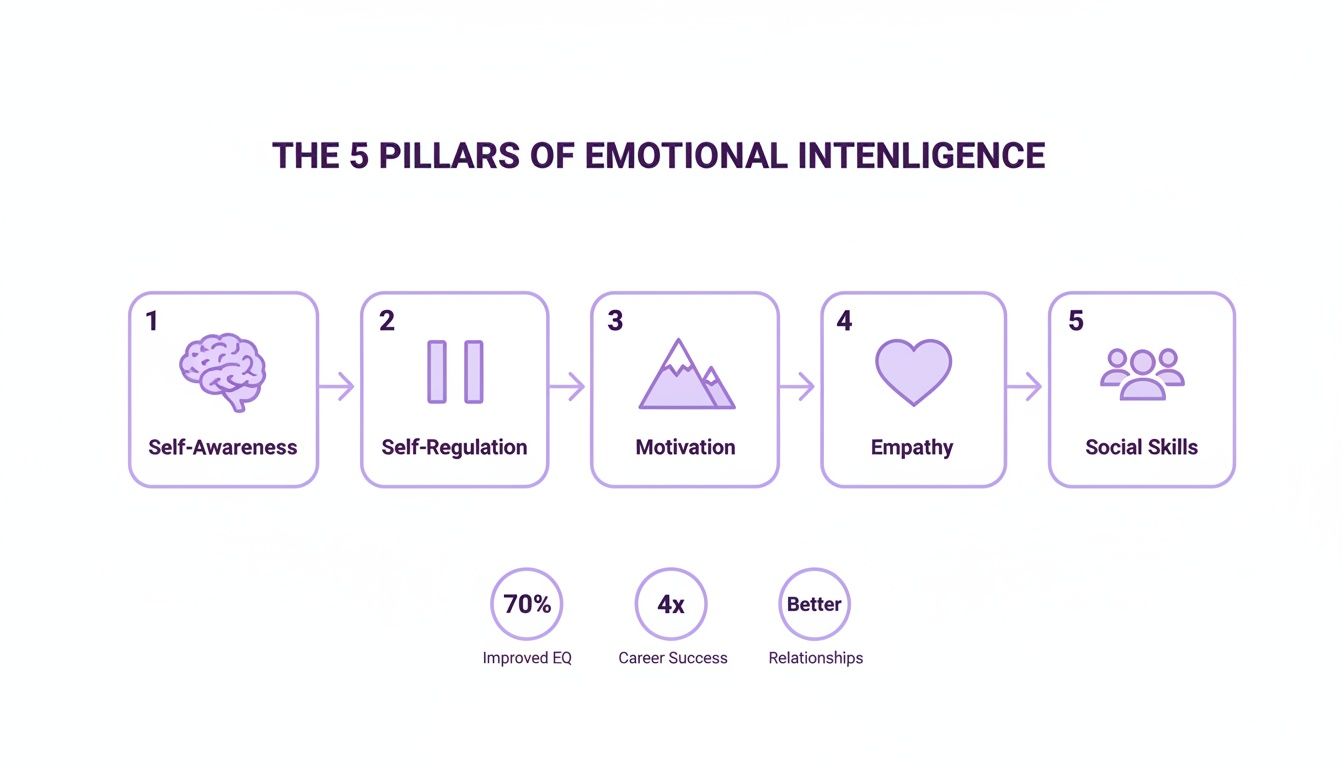
This progression is key. We start with understanding ourselves before we can hope to effectively understand or interact with others.
Weeks 1-2: Building the Bedrock of Self-Awareness
The entire journey starts by looking in the mirror. Without a clear, honest sense of your own emotional landscape, everything else is just guesswork. These first two weeks are all about sharpening your ability to simply notice and name your emotions as they arise, without judging them.
Your goal here is to become a neutral observer of your own inner world.
Core Exercises:
- Daily Emotional Check-ins: Three times a day—morning, midday, and evening—just pause for 60 seconds. Ask yourself, "What am I feeling right now?" Give it a name: frustration, contentment, anxiety, boredom. Don't try to fix it. Just name it.
- Trigger Tracking Journal: At the end of the day, spend five minutes writing about one moment you had a strong emotional reaction. What was the situation? What was the feeling? What happened right before it? This isn't about placing blame; it's about uncovering your personal patterns.
- Body Scan Meditation: Spend 10 minutes before bed simply noticing physical sensations. Where are you holding tension? Is your jaw tight? Are your shoulders relaxed? Emotions often show up in the body before our conscious mind catches on.
A Little Philosophy: The Socratic maxim, "The unexamined life is not worth living," is your mantra for these two weeks. You're learning to see yourself as you are, not just as you wish you were.
Weeks 3-4: Mastering the Art of Self-Regulation
Now that you're getting better at identifying what you feel, it's time to work on how you respond. Self-regulation is the critical skill of managing your emotional reactions, preventing disruptive feelings from hijacking your behavior. This is all about creating a little bit of space between a trigger and your response.
This is where you shift from being reactive to being responsive.
Core Exercises:
- The 4-7-8 Breath: When you feel a trigger coming on (one of those moments you identified in your journal), stop and do this. Inhale for 4 seconds, hold your breath for 7, and exhale slowly for 8. It's a physiological reset button that calms your nervous system and pulls you out of a fight-or-flight state.
- Cognitive Reframing: Pick a recurring negative thought from your journal. For instance, if critical feedback sends you into a spiral of "I'm a failure," consciously challenge that thought. Write down three alternative, more balanced interpretations. Maybe: "This is just one piece of feedback on one project," or "They're trying to help me improve the final outcome."
- The 15-Minute Rule: Make a pact with yourself. When you feel an overwhelming urge to react—to fire off that angry email or make a sarcastic comment—you must wait 15 minutes. Use that time to breathe or walk around the block. The goal is to prove to yourself that you are in control of your impulses.
Weeks 5-6: Turning Your Attention to Empathy
Once you have a better handle on your own emotional world, you can start turning your attention outward. Empathy isn't about feeling sorry for someone; it's the ability to genuinely understand and share what another person is feeling. It means setting your own perspective aside for a moment to see the world through their eyes.
Empathy is the bridge connecting your internal growth to your external relationships.
Core Exercises:
- Daily Perspective-Taking: Once a day, pick someone you interacted with—a coworker, a barista, a family member. Spend five minutes actively imagining their day from their point of view. What might their stresses be? What could be making them happy? It’s a workout for your empathy muscle.
- Practice Active Listening: In your next real conversation, your only goal is to understand the other person, not to formulate your reply. When they pause, summarize what you heard them say. Start with something like, "So, it sounds like you're feeling frustrated because…" and wait for them to confirm before you share your own thoughts.
- Expand Your Media Diet: Intentionally read a book, watch a documentary, or listen to a podcast from a perspective that is completely different from your own. Pay close attention to the emotional journey of the people involved.
Weeks 7-8: Putting It All Together with Motivation and Social Skills
In the final two weeks, we bring everything home. This is about connecting your actions to your deeper "why" (intrinsic motivation) and using your newfound awareness to navigate social situations with more grace and skill.
This is where your emotional intelligence becomes a visible, active part of who you are. For those wanting to really dive deep into these skills in a more guided setting, it's worth exploring structured programs. You can learn more about our evidence-based personal development courses to see how these principles are applied in a learning environment.
Core Exercises:
- Align Actions with Values: At the start of the week, write down your top three personal values (like integrity, growth, or compassion). Each day, identify one small thing you did that was aligned with one of those values. This practice powerfully reinforces your internal motivation.
- Initiate a Mindful Conversation: Start a conversation with someone where your goal isn't to solve a problem or persuade them of anything, but simply to connect. Use your active listening and empathy skills to make them feel truly heard and seen.
- Give and Receive Feedback with EQ: Find an opportunity to give someone constructive feedback. Focus on the specific behavior, not the person, and deliver it calmly. Then, ask a trusted peer for some feedback on yourself. Listen with genuine curiosity, using your self-regulation skills to manage any defensiveness that might pop up.
This eight-week roadmap is a powerful starting point, but remember that this is a lifelong practice. Be patient with yourself, celebrate the small victories, and stay curious.
Don't Let These Common Roadblocks Derail Your EQ Growth
Let's be real: the journey to build emotional intelligence isn't always a smooth, uphill climb. It’s more like navigating a winding trail, complete with unexpected detours and a few frustrating stumbles. Knowing what these common roadblocks look like ahead of time is your best strategy for moving past them, rather than getting stuck.
One of the sneakiest pitfalls I see is intellectualizing feelings. This happens when you get really good at thinking and talking about your emotions, but you aren't actually feeling them. You might be able to perfectly articulate the causes and patterns of your anxiety, but you remain completely disconnected from the actual knot in your stomach or the frantic beat of your heart. It creates a chasm between your mind and your body, which is the exact opposite of self-awareness.
Getting Out of Your Head and Into Your Body
To close that gap, you have to learn to drop out of your analytical mind and into your physical self. This is where body-based, or somatic, practices are worth their weight in gold. They pull your awareness right into the present moment, which is the only place emotions truly exist.
- Try a Somatic Check-In: A few times throughout the day, just pause. Ask yourself, "Where is this feeling showing up in my body?" Don't judge or analyze it. Simply notice. Is it a tightness in your shoulders? A buzzing in your hands? A hollowness in your chest? This simple act starts to rebuild the connection to your body's direct emotional signals.
Another challenge that trips people up is emotional overwhelm. As you start paying more attention, you might accidentally open the floodgates to a rush of difficult feelings you've been unconsciously pushing down for years. The sheer intensity can be shocking, making it tempting to slam the door shut and go back to your old avoidance tactics.
This is a completely normal, and often necessary, part of the process. It's a sign that the old walls are coming down. The trick is to learn how to manage the flow without getting swept away.
A powerful psychological technique for this is called containment.
- Use the 'Containment' Visualization: When an emotion feels like too much, close your eyes. Picture a strong, secure container—maybe it’s a heavy oak chest, a bank vault, or a beautiful, sturdy box. Imagine carefully placing the overwhelming feeling inside it and locking it away. You can assure yourself it's safe and you'll come back to it when you feel more resourced. This isn't the same as suppression; it's a conscious choice that puts you back in the driver's seat.
How to Measure What Actually Matters
Finally, it's easy to get bogged down by a lack of consistency or the hunt for a perfect EQ "score." You start wondering, "Is this even working? My score hasn't changed!"
That’s the wrong way to look at it. Meaningful emotional growth isn't about gamifying your inner world. Instead of chasing a number, shift your focus to the qualitative signs of progress—the small but profound changes in how you navigate your life.
Keep an eye out for shifts like these:
- Quicker Rebound Times: You still get triggered or frustrated, but you don't stay there as long. The emotional "hangover" that used to last for days now clears up in hours, or even minutes.
- More Thoughtful Communication: You catch yourself pausing before reacting in a heated discussion. You're getting better at saying what you really mean and hearing the needs behind someone else's words.
- A Kinder Inner Voice: When you mess up, that harsh inner critic is a little quieter. You find yourself offering the same kindness and understanding to yourself that you would give to a good friend.
Focusing on these real-world wins is what makes the work stick. And the effort is absolutely worth it. Research shows that people with high emotional intelligence consistently earn more and are found in top leadership roles. The best part? EQ isn't fixed. Further research demonstrates that when organizations invest in EQ, they see tangible improvements in productivity and innovation. To learn more about this powerful connection, you can read more about emotional intelligence in the workplace.
Weaving Emotional Intelligence into Your Daily Fabric
Following a structured roadmap is a great way to kickstart your progress, but the real magic happens when you move beyond the exercises. True emotional intelligence isn't something you "do" for an hour a day; it's a way of being that you cultivate moment by moment. The goal is to get to a point where these skills become your default setting, seamlessly integrated into who you are.
This isn't about a massive overhaul. It’s about weaving small, intentional actions into your routine until they feel as natural as breathing.
From Conscious Practice to Natural Presence
Instead of carving out dedicated "EQ time," start looking for opportunities to flex these muscles in real-time. Think of it less as homework and more as a collection of micro-habits that keep you grounded and aware throughout the day.
Here are a few simple ways to get started:
- The Morning Emotional Check-In: Before your hand even reaches for your phone in the morning, pause and check in with yourself. Simply ask, "How am I feeling as I start this day?" This small act kicks off your morning with a dose of self-awareness.
- Seek One Different Perspective: Make it a point each day to truly listen to someone with a viewpoint different from your own. The goal isn't to debate or agree—it's to understand the emotional logic behind their perspective. This is empathy in action.
- The 30-Second Transition: As you shift from one activity to another—wrapping up a meeting, leaving work, walking in your front door—take just 30 seconds to pause. Notice your current emotional state, take a breath, and consciously decide what energy you want to bring into the next part of your day.
These aren't huge, time-consuming commitments. They are the small hinges that swing big doors, gradually shifting how you navigate your world.
Why This Matters More Than Ever
This isn't just a "nice-to-have" skill anymore. The world is catching on to the profound impact of emotional intelligence. In fact, the global EQ market is expected to explode from $2.6 billion in 2024 to a staggering $23.0 billion by 2035.
Even the World Economic Forum has flagged emotional intelligence as a top professional skill for 2025. This isn't a fad; it's a fundamental recognition that EQ is essential for thriving in our modern world.
The journey to build emotional intelligence is a marathon, not a sprint. The aim isn't perfection; it's progress. It’s about choosing awareness over autopilot, empathy over judgment, and connection over conflict—one small moment at a time.
This path of conscious living is a continuous discovery. By simply starting, you've already taken the most important step. Acknowledge how far you've come, and stay curious about the person you are becoming. For those looking to go even deeper, our book explores how this inner work leads to a more fulfilling life and can help you find your own Harmony Within. Remember, it’s the small, consistent actions that create the most profound and lasting change.
A Few Common Questions on the Path to Higher EQ
As you get started, you're bound to have some questions. That's a good thing. It means you're engaged in the process of turning these ideas into real-world practice. Here are a few of the most common things people wonder about when they begin.
Is Emotional Intelligence Something I'm Born With, or Can I Actually Change It?
This is the big one, and the answer is a clear and resounding yes, you can absolutely develop it. Decades of psychological research have shown that emotional intelligence isn't a fixed trait like your eye color. It's a flexible set of skills that can be learned, practiced, and strengthened throughout your entire life.
Think of it this way: your IQ tends to level off in your late teens, but your EQ is much more like a muscle. With consistent and focused effort, you can make it stronger. Philosophically, this isn't a new concept at all. The ancient Stoics built their entire worldview on the idea that we can train our emotional responses. The fact that recent studies show a decline in global EQ scores also proves it’s not set in stone. If it can go down due to external pressures, it can definitely be built back up with intentional effort.
Believing that you can grow emotionally is the first—and most important—step. It’s a fundamental part of the human experience to learn and adapt.
With So Many Components, Where Should I Even Begin?
While all five pillars of EQ work together, nearly every expert I know agrees on one thing: Self-Awareness is the foundation for everything else. It’s the starting block.
After all, you can't manage an emotion you don't even notice. You can't genuinely empathize with someone else's feelings if you can't identify your own. Starting here is the most practical first move you can make. It can be as simple as pausing to non-judgmentally notice what you're feeling, thinking, and sensing in your body. That simple practice creates a tiny bit of space between a trigger and your reaction—and in that space, you find the power to choose.
How Long Until I Start Seeing a Real Difference?
There’s no magic number, but with consistent daily practice, you can feel a shift surprisingly fast. Many people I've worked with report a greater sense of calm and self-control within the first 2 to 4 weeks, especially when they commit to a daily journaling or check-in habit.
Bigger changes, particularly in how you handle relationships and complex social situations, often take a bit longer to become second nature, usually showing up around the 3 to 6-month mark. The trick is to reframe what you're looking for. Instead of asking, "Am I a master of EQ yet?" try asking, "Am I a little more aware of my reactions today than I was last month?" Focus on the process, not a finish line.
This path is a continuous journey of growth toward a more conscious and fulfilling life. At Joseph Kelly, we build evidence-based tools and courses that blend practical psychology and philosophy to help you along the way. Our goal is to help you turn insight into action.
To discover practical skills for your own well-being, come visit us at https://josephkelly.net.