Think of your core values as your personal internal compass—the fundamental beliefs that quietly steer your actions and shape your character. Getting clear on them is the first step toward building a life that feels authentic and truly fulfilling, not just one you've stumbled into.
Why Identifying Your Core Values Is a Non-Negotiable

Let’s move past the surface-level advice. Understanding your core values isn't just a feel-good exercise; it’s a foundational practice for living with integrity and purpose. Philosophers from Aristotle, who championed the concept of eudaimonia (a life of flourishing), to modern existentialists like Jean-Paul Sartre have centered on this idea—that our chosen values provide the very framework for a meaningful life. They are the principles you hold most dear, the ones that guide you toward choices that feel right, deep down.
Psychologically, this clarity is essential for well-being. When your day-to-day actions reflect your deepest beliefs, you experience what Acceptance and Commitment Therapy (ACT) calls value-congruent living. This alignment is a powerful antidote to the mental chatter of indecision and the chronic stress that creeps in when your life feels off-kilter or inauthentic.
The Power of an Internal Compass
Imagine trying to navigate a dense forest without a compass. You’d be reacting to every rustle in the leaves, following every random path, and likely ending up lost. That’s what life is like without defined values—you're guided by external pressures, other people’s expectations, or fleeting whims. It's a recipe for dissatisfaction and burnout.
When you define your core values, you give yourself a reliable navigation system. It makes decision-making, both big and small, so much clearer.
For instance, if "Adventure" is a top value, taking a calculated career risk feels exciting and right. But if "Security" is your north star, you'll find genuine peace in building a stable foundation. This internal clarity, a key component of self-awareness, makes life feel less like a constant struggle and more like a true expression of who you are.
The benefits aren't just theoretical; they are significant and well-documented.
A 2022 study of 50,000 participants found that people who clarified their top three values reported 25% higher life satisfaction after just six months.
This clarity doesn't just improve how you feel; it enhances how you function. Research also shows that this self-awareness boosts decision-making speed by an impressive 40%, helping you act with more confidence. You can discover more about the research behind human values and their direct impact on our lives.
Here’s a quick overview of the key pillars in the values discovery process, giving you a snapshot of the journey ahead.
Your Roadmap to Value Identification
| Pillar | Core Action | Psychological Benefit |
|---|---|---|
| Reflection | Probing past experiences to uncover recurring themes and emotions. | Connects your present self with authentic past motivations. |
| Identification | Using a comprehensive list to brainstorm and select potential values. | Expands self-awareness beyond your usual vocabulary. |
| Prioritization | Sorting and ranking your selected values to find the vital few. | Creates a clear hierarchy for easier decision-making. |
| Validation | Testing your top values against real-life scenarios and future goals. | Ensures your values are practical and truly your own. |
This roadmap isn't just a list of steps; it's a framework for building a more conscious and intentional way of living.
Building a Foundation for Authentic Living
This journey is about much more than just jotting down a list of inspiring words like "honesty" or "courage." It’s about digging deep to understand what those words truly mean to you and how they show up in your actual behavior. Philosophically, this is the difference between an abstract concept and a lived virtue.
The process we're about to explore is designed to help you:
- Slash decision fatigue. When you're at a crossroads, you can simply ask, "Which option aligns best with my values?"
- Fuel your motivation. Goals rooted in your core values feel inherently meaningful, making them far easier to stick with.
- Strengthen your relationships. When you live authentically, you naturally attract people who resonate with the real you.
Ultimately, identifying your core values is a non-negotiable step toward a life of purpose and integrity. It's the essential groundwork for everything else you want to build.
Look to Your Life for the Real Clues

The most powerful way to find your core values isn't to just scan a generic list and pick a few that sound good. The real truth is buried in your own life experiences. This idea is grounded in narrative psychology—the concept that we make sense of who we are through the stories we tell ourselves. Your life is packed with data points that point directly to the principles you already live by, often without even realizing it.
So, instead of asking, "What are my values?" we're going to ask much better questions. We’ll examine those moments of intense emotion—the absolute highs, the gut-wrenching lows, and the times you felt serious friction. This is where your values show up most clearly. Think of yourself as an emotional archaeologist, digging through your own history to uncover the artifacts that truly define you.
What Your Best Moments Tell You
Start by thinking of a time when you felt truly alive and proud. A moment of genuine fulfillment. Don't overthink it; just let a memory come to the surface. Maybe it was finishing a project that pushed your limits, standing by a friend during a crisis, or finally mastering a skill you’d been working on for months. Psychologists refer to these as "peak experiences," moments that often reveal our highest potentials and deepest values.
Once you have that moment in your mind, really dissect it. Ask yourself:
- What was I actually doing that made me feel so good?
- Who was with me, and what was our dynamic like?
- What deep-seated principle was I honoring in that moment?
For instance, if you recall organizing a community fundraiser with a sense of pride, the value isn't just "helping." Look closer. Was it about bringing people together (Community)? Making a tangible difference (Impact)? Or stepping up to guide the effort (Leadership)? The specific feeling you had is your guide.
What Your Frustrations Reveal
Just as our peak moments highlight what we cherish, our frustrations and struggles reveal what we can't stand. Think about a time you felt angry, deeply disappointed, or just completely burned out. What was going on? Nine times out of ten, these negative feelings flare up when one of our core values is being stepped on. Psychologically, this is known as value-violation, a potent source of stress and internal conflict.
Consider a conflict you had at a past job. Were you angry because a micromanager was suffocating your Autonomy? Or did you witness something unfair, triggering your value of Justice or Fairness? These moments of friction are gold mines for identifying what truly matters to you.
This isn't just a feel-good exercise. When your life choices don't align with your core beliefs, the consequences are real. A massive Gallup meta-analysis of one million workers found this misalignment predicts a 45% higher rate of burnout.
Looking inward is a proven strategy. In the 2022 America's Values Study, a survey of over 2,000 U.S. adults, a striking 61% named 'family' as their number one value. This shows just how much our most fundamental relationships inform our principles. You can dig into more findings about how Americans identify their values from the study.
Start Your Raw List of Values
As you reflect on these highs and lows, start jotting down the words and phrases that pop into your head. This is a brainstorming phase, so don't filter or judge anything yet. The goal is simply to capture the essence of what was important in each story. If a memory of a difficult career change keeps surfacing, maybe the underlying value is Freedom or Self-Direction.
This approach grounds your values in real, lived experiences, making them far more potent than abstract ideas on a page. Your memories are the proof. For more on this, you might find our guide on how memory shapes your identity to be a useful resource. This initial list, built from authentic moments, is the bedrock for everything that comes next.
Refining Your List to Uncover Your Personal Truths
If you've followed the reflective prompts so far, you probably have a long, rich, and maybe slightly overwhelming list of words that resonate with you. That's a great sign. It means you've dug deep. Now, the real art is in distilling that raw material into the handful of principles you simply can't live without.
This is where we move from a broad collection of nice-sounding ideals to a clear, actionable personal philosophy.
Finding Themes in the Chaos
The first practical step is to play detective with your own list. Look for themes and patterns. You'll likely notice that several words are pointing to the same core idea. Psychologists call this process thematic analysis, a way of finding the underlying structure in qualitative data—in this case, your personal reflections.
For example, maybe you wrote down "kindness," "empathy," and "generosity." They're all different, yet they orbit a central concept. You could group them under a single, more powerful theme like Compassion. Similarly, if your list has "freedom," "independence," and "self-reliance," the real driver underneath might be Autonomy.
This isn't about losing nuance; it's about simplifying your list so you can see the big picture of what truly motivates you.
Sorting Through Tough Choices
Once you have your themes, the real work begins. The most powerful way to discover what's truly essential is to force a choice between two good options. It's in these dilemmas that our deepest priorities reveal themselves. This is a practical application of the philosophical method of using thought experiments to clarify one's positions.
This isn't about throwing good values away; it's about establishing a personal hierarchy.
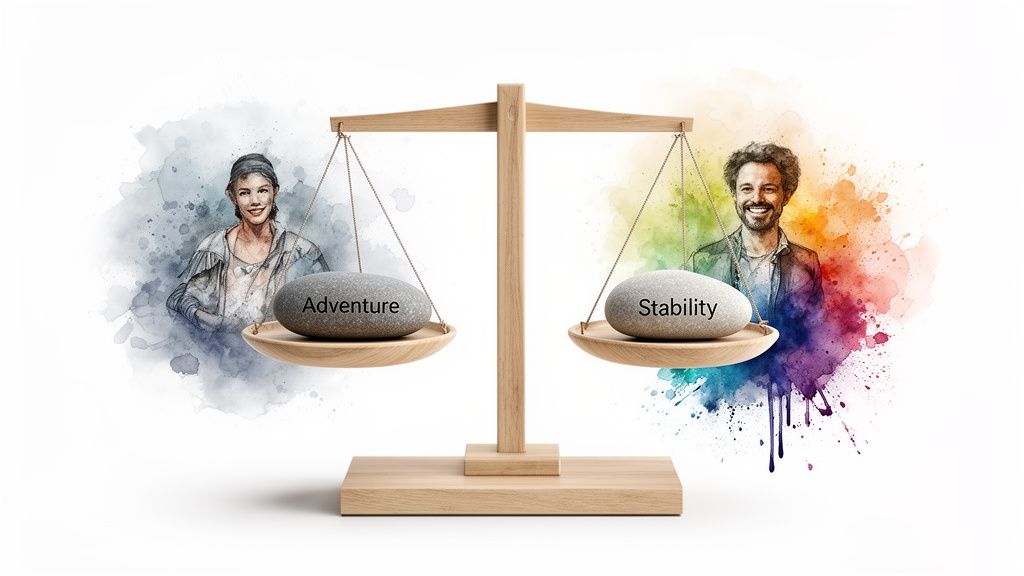
Let’s say "Adventure" and "Stability" both made your shortlist. To figure out which one sits higher, ask yourself some tough questions:
- If you were offered a dream job that guaranteed immense Stability but meant giving up spontaneous travel (Adventure), which would feel like a greater sacrifice?
- In a long-term relationship, would you be more fulfilled with a partner who prioritizes a secure, predictable life (Stability) or one who constantly pushes you to explore new things (Adventure)?
There's no right answer here, only your answer. This forced-choice exercise makes you confront what's indispensable versus what's just a "nice-to-have." This is a crucial distinction when you're figuring out how to identify your core values.
By making these tough hypothetical choices, you're uncovering the internal "rules" you use to navigate life. You're defining the principles that, if violated, would make you feel fundamentally inauthentic.
This process isn't just a thought exercise; it reflects deep psychological frameworks. A 2025 synthesis of motivation research identified five core dimensions that drive us, including Individual Mastery and Interpersonal Relatedness. This helps explain why some of us instinctively prioritize skill acquisition (which can boost career satisfaction by 28%) while others focus on connection (reporting 35% stronger relationships). You can find more insights on what core values direct your life and see how they shape your priorities.
Navigating Common Value Conflicts
It's common for core values to seem like they're in opposition. For instance, how do you balance a deep need for community with a fierce desire for independence? Finding harmony is about integration, not sacrifice. It's about figuring out how to honor both, even when it’s tricky.
Here’s a look at how to navigate some of these common tensions:
| Conflicting Values | Example Scenario | Path to Integration |
|---|---|---|
| Growth & Contentment | Feeling restless in a stable job you enjoy, but worried about losing what you have if you chase something bigger. | Find ways to grow within your current role. Propose a new project, mentor a junior colleague, or take an online course. This honors both the desire for stability and the need for progress. |
| Connection & Autonomy | Wanting deep relationships but also needing significant alone time to recharge and pursue personal interests. | Communicate your needs clearly. Schedule both dedicated social time and protected "me time." The right people will respect your need for both connection and space. |
| Security & Adventure | Craving the thrill of travel and new experiences but also feeling the pull of a stable home life and financial security. | Plan for "micro-adventures" or set up a dedicated savings fund for a larger trip. This allows you to experience novelty without completely upending your need for a secure foundation. |
Ultimately, living a values-aligned life isn’t about choosing one over the other forever; it's about learning to dance between them.
Aiming for the Essential Few
Keep repeating this prioritization process, pitting different values against each other. As you do, a clear pattern will emerge. You'll notice that certain values consistently win out, feeling absolutely essential to who you are.
Your goal is to narrow your list down to the 3-5 core values that feel the most potent and true.
These final values become your personal compass. They're the principles you can lean on to make tough decisions, set goals that actually matter to you, and build a life that feels genuinely your own.
For additional tools and worksheets to help with this process, check out our collection of free personal development resources.
Time to Road Test Your Core Values
Getting your core values down on paper is a fantastic start, but let's be honest—it's just a list of words. The real magic happens when you take them off the page and into your actual life. This is where you find out if they truly fit.
Think of it like trying on a new pair of shoes. They might look great in the box, but you have to walk around in them to know if they're right for you. This "road test" phase is all about moving from theory to reality. This process mirrors the scientific method: form a hypothesis (these are my values) and then test it through experimentation.
Designing a Few Real-World Experiments
The goal here isn't to overhaul your entire life overnight. Instead, you're going to create small, low-stakes experiments for each of your top 3-5 values. You're basically a scientist in a lab of your own life, gathering data on what makes you tick.
The key is to design a specific, observable action you can take over a short period, like a week. It needs to be simple enough that you'll actually do it.
Here are a few ideas to get the wheels turning:
- Value: Creativity: For one week, do one small creative thing each day. Don't overthink it. It could be doodling for 15 minutes, taking a different route on your walk and noticing new things, or trying to invent a new sandwich.
- Value: Community: Intentionally connect with one person this week you wouldn't normally talk to. Or, find a one-off local event—a park cleanup, a farmers' market, a library talk—and just show up.
- Value: Growth: Spend 30 minutes a day learning something totally new. Download Duolingo and learn five new words, watch a documentary on a topic you know nothing about, or find a YouTube tutorial for a skill you've always been curious about.
Remember, the action itself matters less than the intention behind it. You're creating a scenario to see if living this way actually fuels you.
Tuning In to Your Real Reaction
After you try one of these little experiments, you need to check in with yourself. This part is critical. You're not grading your performance; you're just noticing how you felt. This practice of self-observation, or introspection, has roots in both philosophy and early psychology, serving as a primary tool for understanding the self.
Ask yourself these simple questions:
- Did that give me energy, or did it drain me? A true core value should leave you feeling more alive, even if the activity itself was hard. It’s a “good-tired” feeling, not a “thank-goodness-that’s-over” feeling.
- Did that feel like me? Or was I putting on an act? When you’re aligned with your values, it feels natural, like settling into a comfortable chair. If it feels forced, like you’re playing a part, that’s important information.
- Did I feel a sense of satisfaction? Sometimes, acting on a core value just brings a quiet, internal hum of rightness.
If an activity consistently feels like a heavy chore or a box you just have to check, that value might be more of an aspiration than a reality. It could be a "should" value—one you think you should have—instead of a genuine "must" value that's part of your DNA.
This final step of testing and reflecting is what solidifies your choices. It ensures the values you move forward with aren't just admirable concepts, but the principles that genuinely make you feel like your most authentic self.
Weaving Your Values into Your Everyday Life
You’ve done the hard work of digging deep and figuring out what truly matters to you. That’s a huge step. But here’s the thing: values on paper are just words. Their real power kicks in when you put them into action.
This is where self-discovery turns into self-direction. It's the moment you stop just knowing your values and start living them. It can feel like a big jump, but the trick is to start small and be deliberate. You're simply weaving these core principles into the decisions, habits, and goals that already make up your life.
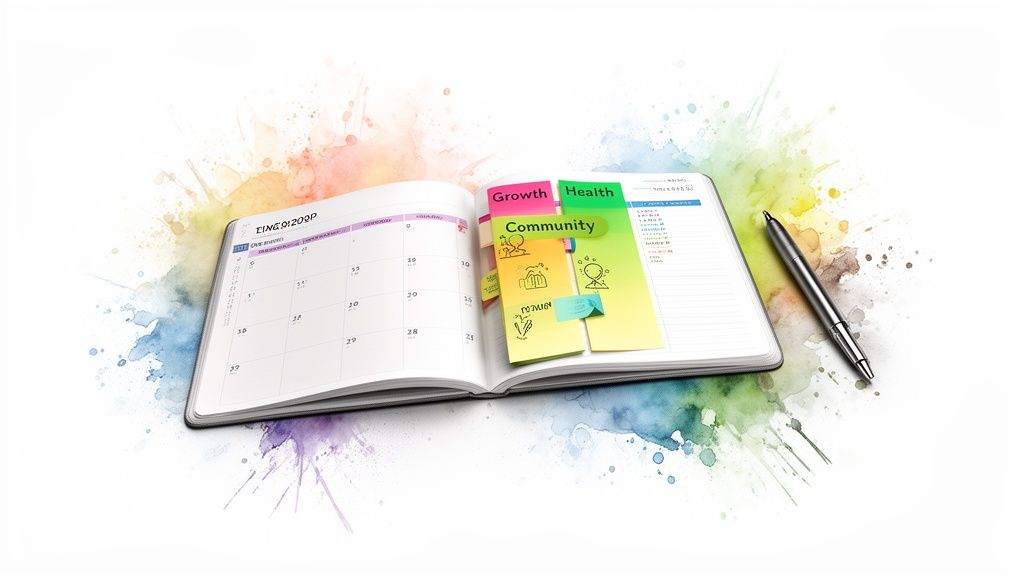
Start With a Personal Values Audit
Before charging ahead, it’s incredibly helpful to get a clear picture of where you are right now. Think of it as a "Values Audit"—a simple, honest look at how your current life lines up with your newly defined principles. No judgment allowed.
Go through the main areas of your life and ask a straightforward question: “How well does this part of my life reflect my value of [your value]?”
- Your Career: Does your job honor your value of Autonomy, or are you being micromanaged every day?
- Your Relationships: If you value Deep Connection, is your social life full of meaningful interactions or just surface-level catch-ups?
- Your Health: You might value Vitality, but do your daily habits actually support your physical and mental energy?
The point here isn’t to make you feel bad. It’s all about awareness. This audit gives you a map, showing you where you're already thriving and where there are friction points causing that nagging sense of dissatisfaction.
Looking back at tough choices you've made—which job to take, who to spend time with—can reveal so much. You'll see what you've prioritized in the past and spot where you might have drifted from what's truly important to you.
Design Goals That Actually Mean Something
Once you see the gaps, you can start closing them. How? By setting goals that are a direct expression of your values. This completely changes the game. Instead of chasing external achievements, you start building a life that feels authentic and fulfilling from the inside out. Research from Self-Determination Theory shows that goals aligned with intrinsic values lead to greater persistence and well-being.
A value isn't a finish line; it’s the direction you want to head. A goal is just a marker on that path.
Here’s what that looks like in practice:
If you value: Growth
- Your goal might be: "Get that professional certification I've been thinking about by the end of the year."
- Or maybe: "Read one non-fiction book a month on a topic I'm totally clueless about."
If you value: Community
- Your goal could be: "Volunteer for that local animal shelter twice a month."
- Or even: "Host a potluck for my closest friends every other month to really connect."
When your goals are anchored to your values, you find a much deeper well of motivation. Setbacks don't derail you as easily because the "why" behind your effort is so personal and powerful. You're not just checking a box; you're actively creating a life that feels less like an accident and more like your own masterpiece.
Answering Your Questions About Core Values
Even with a roadmap, this kind of personal work often brings up a few questions. That's a good thing—it means you're digging deep. Let's tackle some of the most common ones I hear, so you can keep moving forward with confidence.
How Often Should I Revisit My Values?
While your core values are generally stable, they aren't meant to be carved in stone forever. Life happens. A new job, a big move, the start or end of a relationship—these major shifts can absolutely bring new clarity to what matters most. Philosophers call these "formative experiences," events that reshape our understanding of ourselves and the world.
I recommend a "values check-in" about once a year, or anytime you go through a significant life change. Think of it less as changing who you are and more as deepening your understanding of yourself. It’s about making sure your internal compass is still pointing true north for you, right now.
What If My Values Seem to Clash?
First off, don't panic. This is completely normal. In fact, it's a sign that you're a complex, thoughtful human being. It's incredibly common to hold values that feel like they're pulling you in opposite directions, like wanting both Adventure and Security, or valuing both Community and Autonomy.
The goal here isn't to pick a winner and discard the loser. It's about finding a creative, dynamic balance that honors both.
Recognizing these internal tensions is a huge part of the work. It’s what allows you to make conscious, nuanced choices instead of feeling stuck or pulled apart.
For example, someone who values both Security and Adventure might build a stable, secure home life that acts as a launchpad for well-planned travels. Or you could honor your need for Autonomy with dedicated solo time while still making space for the deep connections that fulfill your value of Community.
What's the Real Difference Between Values and Goals?
This is a crucial distinction, and getting it right is the key to actually living your values instead of just knowing them.
Values are your "why." They’re the guiding principles for how you want to move through the world. They're like a compass direction—always there to orient you. Think "Honesty," "Creativity," or "Growth." In psychological terms, they are motivators that define a desired state of being.
Goals are your "what." They are the specific destinations you want to reach. Goals have a finish line. "Write a novel," "Run a marathon," or "Get that promotion" are all goals. They are the concrete manifestations of your values.
Here's the magic: Your most fulfilling and sustainable goals will always be the ones that are a direct expression of your values. When a goal is tied to something you deeply believe in, the motivation to see it through comes from within, making the entire journey more meaningful.
At Joseph Kelly, we focus on providing research-backed tools and frameworks that help you turn self-discovery into real-world, intentional action. If you're ready to keep building a life that truly aligns with what matters, we have resources to help you. Find your path today.