
The relationships that matter most to us have a peculiar quality. They are simultaneously the places where we feel most like ourselves and the places where we lose ourselves most completely.
You probably know what I mean. You enter a significant relationship carrying genuine intentions, real self-awareness, and what feels like a solid sense of who you are. Then something happens. A look, a tone of voice, a comment that lands in a particular way. And suddenly you’re reacting from somewhere older and less considered than the person you thought you were, saying things you didn’t plan to say, feeling things you can’t quite name, behaving in ways that afterward you barely recognize as yours.
The previous article in this series explored why cognitive sovereignty — the capacity to think clearly and make conscious choices — depends more thoroughly on the quality of our relationships than most conversations about mental clarity tend to acknowledge. This one goes one layer deeper, into the terrain that sits beneath both cognitive and relational functioning: your relationship with your own emotional life. Because here’s what I’ve found to be consistently true, both in the research and in the work I do with people navigating these questions: you cannot be relationally sovereign without first developing emotional sovereignty. The outer relationship with others will only ever be as healthy as your inner relationship with yourself.
What Emotional Sovereignty Actually Means
Let me say first what it doesn’t mean, because the most common misunderstandings about emotional sovereignty tend to create exactly the problems they’re trying to solve.
It doesn’t mean managing your emotions. It doesn’t mean staying calm, maintaining your composure, or developing sufficient self-discipline to keep difficult feelings from surfacing at inconvenient times. That approach — treating emotions as something to be controlled, minimized, or strategically deployed — is closer to emotional suppression than emotional sovereignty, and the research is fairly clear about where suppression leads. Gottman’s longitudinal studies on relationships show that emotional flooding during conflict is genuinely corrosive, but so is the chronic suppression that precedes it. The pressure builds somewhere.
It doesn’t mean emotional independence, either. The goal isn’t to become someone who is unaffected by others, unmoved by loss, untouched by intimacy. That kind of self-containment is its own form of disconnection, and it tends to produce relationships characterized by surface-level safety and genuine distance.
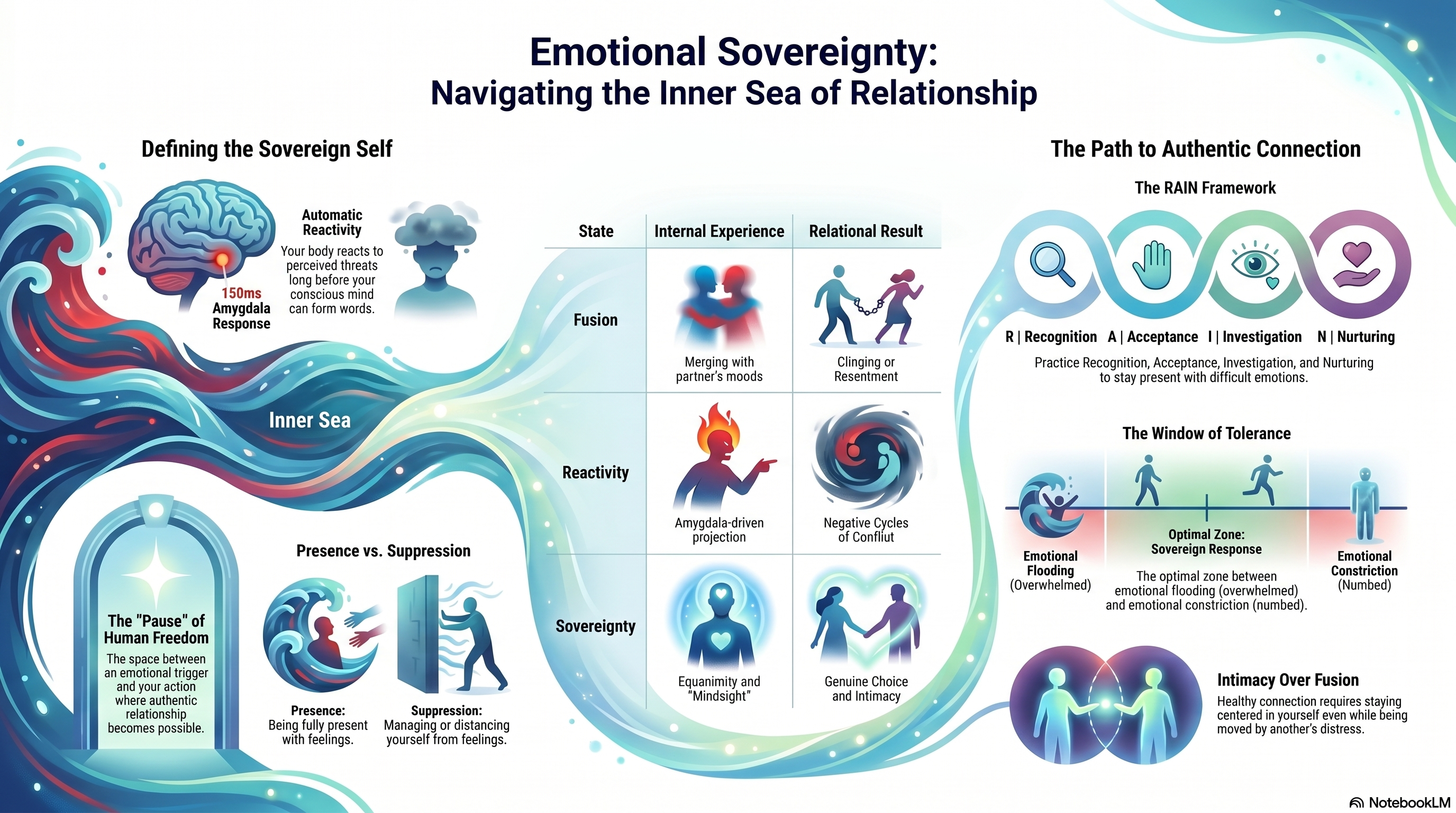
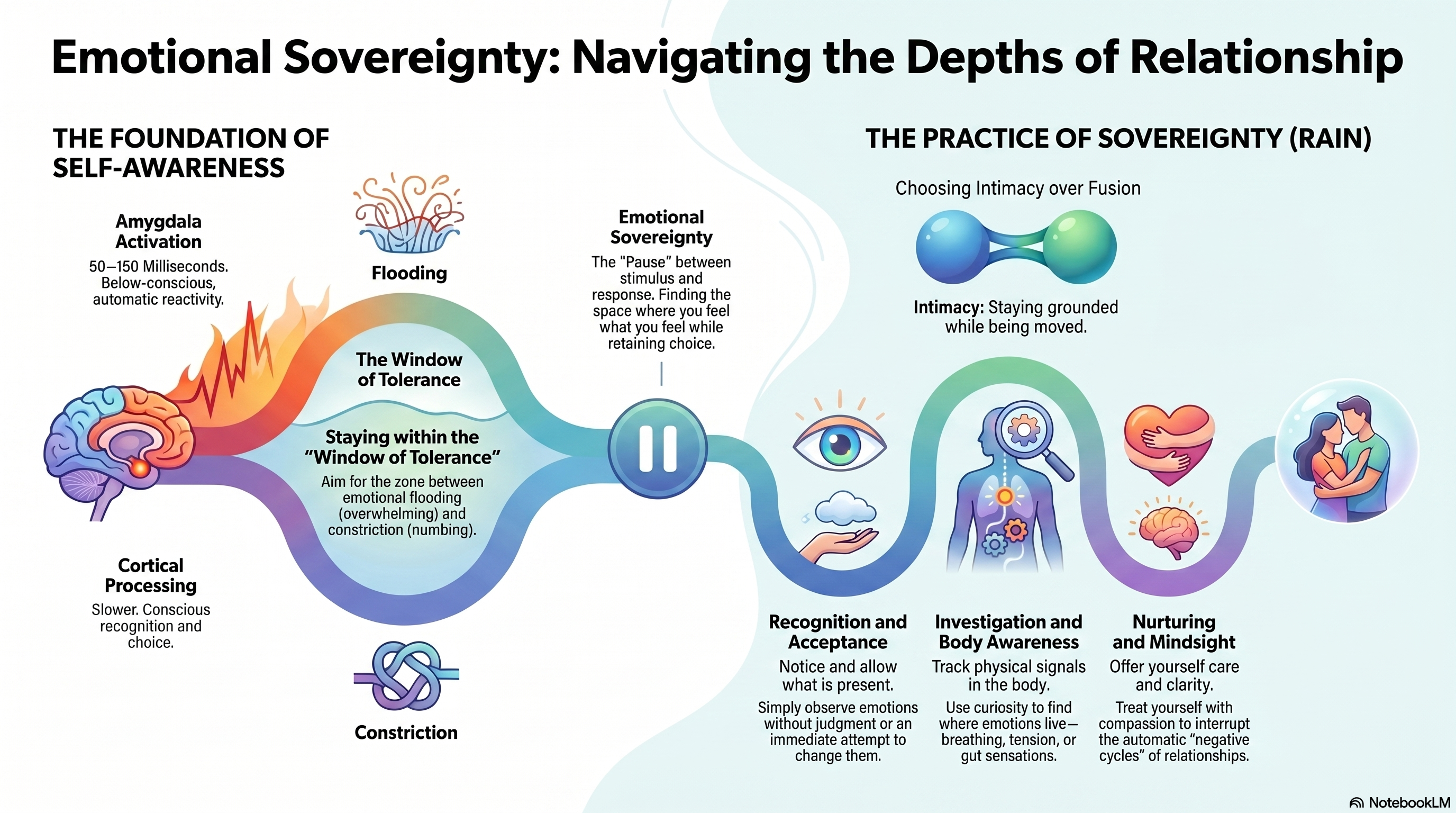
Emotional sovereignty is something more interesting than either of those. It’s the capacity to be fully present with your own emotional experience — to feel what you actually feel, with awareness and some degree of equanimity — while retaining the ability to choose how you respond. The pause between what arises and what you do with it. Viktor Frankl identified this pause as the space where human freedom actually lives. I’d add that it’s also where authentic relationship becomes possible.
Daniel Siegel’s neuroscience research gives us useful language for this. He describes the “window of tolerance” as the zone between emotional flooding — where feelings become so intense they override cognitive functioning — and emotional constriction, where feelings get suppressed or numbed to the point that important information is lost. Within that window, emotions serve their actual purpose: they’re information about your needs, your values, your responses to the world. Outside it, in either direction, they tend to run the show in ways that leave you reacting rather than responding.
The development of emotional sovereignty is, in large part, the work of widening that window — gradually building the capacity to be present with increasingly intense emotional experience without being submerged by it. Not through willpower, but through practice, understanding, and what I’d describe as a fundamentally different relationship with your inner life.
Why the Ocean Makes an Apt Teacher
There’s a reason the hero image for this article pairs Hera — the goddess of sacred bonds and committed relationship — with Poseidon, who commands not just the literal sea but everything the sea represents: depth, power, emotional intensity, the parts of experience that move beneath the visible surface and shape everything above it.
Poseidon’s domain is not gentle or predictable. Storms rise without warning. The depths contain things we haven’t seen. The same waters that support navigation can overwhelm it. And critically: you don’t control the ocean. You learn to sail it.
Your emotional life has exactly this quality. Emotions are not generated by conscious choice and they don’t respond reliably to willpower. They arise from neurological processes that operate significantly faster than conscious awareness — the amygdala responds to emotionally salient information within 50 to 150 milliseconds, well before the cortical processing that enables conscious recognition gets involved. Your body is already responding to a threat, a loss, a perceived rejection before your thinking mind has formed a single word about it.
This isn’t a design flaw. It’s adaptive intelligence that evolved for good reasons. The challenge is that these rapid, below-conscious responses were calibrated in conditions that differ substantially from the relational landscape most of us now navigate. When old wounds get activated by present-day relationships, the nervous system responds to the perceived pattern, not to the actual situation. Your partner’s tone of withdrawal triggers the same physiological alarm as your parent’s absence once did, even though they are not the same event, and even though your adult self has resources your childhood self didn’t have.
Understanding this doesn’t make the reactivity stop. But it changes your relationship to it. Instead of experiencing your emotional responses as evidence of weakness or irrationality — something to be ashamed of and hidden — you can begin to approach them with what Tara Brach describes as recognition: simply noticing what’s present without immediately trying to change it.
The Costs of Unexamined Emotional Reactivity in Relationships
The previous article in this series described how unexamined relational patterns can compromise cognitive clarity. Emotional reactivity operates through a related but distinct mechanism, and it’s worth naming specifically because the costs are so often invisible until the damage has accumulated.
When you lack sufficient relationship with your own emotional experience, your significant relationships tend to become theaters for something other than genuine encounter. The person in front of you stops being fully visible as themselves. Instead, they become a screen onto which your nervous system projects its accumulated history. Your partner’s criticism activates old shame. Their silence activates old fears of abandonment. Their success activates old questions about your own adequacy. And you respond — sometimes with defensive aggression, sometimes with withdrawal, sometimes with anxious accommodation — to what you’ve projected rather than to what’s actually happening.
Sue Johnson’s research on emotionally focused therapy maps these patterns in intimate relationships with remarkable precision. She describes what she calls “negative cycles”: sequences in which each person’s emotional reactivity triggers the other’s deepest attachment fears, which then triggers further reactivity, which confirms both people’s worst fears about the relationship. The person who criticizes does so because their fear of disconnection has been activated. Their partner withdraws because their fear of inadequacy has been activated. The withdrawal intensifies the first person’s fear, which intensifies the criticism, which deepens the withdrawal. Both people are responding to genuine pain. Neither person is responding to what’s actually in front of them.
These cycles are not character failures. They’re the predictable outcome of two people navigating significant emotional material without sufficient inner resources to interrupt their automatic responses. The way out isn’t trying harder or caring more. It’s developing what Siegel calls mindsight: the capacity to see your own internal processes clearly enough to make genuine choices about them.
There’s also a subtler cost worth naming. When we haven’t developed our own emotional sovereignty, we tend to outsource our emotional regulation to our relationships. We look to others to manage our anxiety, validate our worth, or confirm that we’re acceptable. The Buddhist framing of “taking refuge” is instructive here: when we take refuge in other people for our fundamental sense of okayness, we create relationships organized around need rather than genuine choice. And relationships organized around need, however understandable their origin, tend to become relationships characterized by either clinging or resentment, often both.
The Paradox That Most People Miss
Here is the thing that counterintuitive research keeps demonstrating, and that I think is worth stating plainly: developing emotional sovereignty doesn’t create distance in your relationships. It creates the conditions under which genuine intimacy becomes possible.
David Schnarch’s research on differentiation in intimate relationships shows that the most deeply satisfying connections are consistently those between people who have developed their own emotional center — people who can be fully present with their partner’s distress without merging with it, who can disagree without their identity becoming destabilized, who can receive love and care without becoming dependent on it for their sense of self.
The distinction between emotional fusion and emotional intimacy is real and significant. In fusion, your emotional state rises and falls with your partner’s moods. Their anxiety becomes your anxiety. Their disappointment feels like evidence of your failure. Their approval becomes necessary for your equilibrium. In genuine intimacy, you can be deeply moved by your partner’s experience while retaining your own emotional ground. You can offer comfort without losing yourself in their pain. You can receive vulnerability without feeling responsible for resolving it.
This is not emotional detachment. It’s the opposite. It requires more genuine presence than fusion does, not less. Fusion is, in some ways, easier: you simply absorb whatever emotional weather arrives and call it connection. Genuine intimacy requires that you actually show up as yourself — which means you have to know who that is, what you actually feel, what you actually need, where your values actually sit. None of that is possible without doing the prior work of developing your own relationship with your inner emotional world.
What the Practice Actually Looks Like
Developing emotional sovereignty is not a project that concludes. It’s an orientation that deepens over time through small, repeated acts of turning toward your own experience rather than away from it.
The most fundamental shift is in how you relate to difficult emotions when they arise. Most of us have learned to evaluate our feelings — this emotion is acceptable, that one is problematic; this level of intensity is fine, that one is too much. This evaluative relationship creates internal conflict that makes genuine sovereignty difficult, because you’re fighting yourself before you’ve even begun to understand what the emotion is trying to communicate.
The alternative is curiosity. Not managed curiosity, not performed openness, but genuine interest in what’s actually happening in your inner life right now. When a difficult feeling arises — anxiety before a conversation, anger in response to a perceived slight, grief that surfaces unexpectedly — the practice is simply to notice it. What does it feel like in the body? Where does it live physically? What does it seem to be about? Not in order to analyze it away, but to be genuinely present with it.
Tara Brach’s RAIN framework offers a useful structure for this: Recognition (noticing what’s present without immediately moving to change it), Acceptance (allowing it to exist without judgment), Investigation (gentle curiosity about what the emotion is communicating about your needs or values), and Nurturing (offering yourself the same care you would offer a good friend in a similar moment). The sequence isn’t mechanical. It’s a direction of attention.
Body awareness matters particularly here, and this connects to something I draw on from my elemental framework: Water, in the system I’ve developed across the Growing Light Series, represents the emotional and intuitive dimension of human experience precisely because emotions are embodied before they are cognitive. They arise as physical events — shifts in breathing, changes in muscular tension, sensations in the chest or throat or gut — before they become thoughts or narratives about themselves. Learning to track these physical signals provides early, more accurate information about your emotional state than the stories your mind tends to build around that state after the fact.
Lisa Feldman Barrett’s research on emotional granularity adds another layer worth understanding. People who have developed more nuanced emotional vocabulary — who can distinguish between disappointment and grief, between irritation and anger, between anxiety and fear — actually experience more sophisticated emotional responses and make more considered decisions in emotionally charged situations. The precision of the language you have for your inner life shapes the quality of your relationship with it. This is one place where reading widely in psychology and philosophy pays off in practical, daily ways: not as intellectual exercise but as the development of a richer inner vocabulary.
Boundaries as Expressions of Emotional Sovereignty
One of the places where the connection between emotional sovereignty and relational health becomes most visible is in the area of limits and boundaries. This is worth examining directly because the conventional framing of limits tends to miss what’s most important about them.
Limits are not primarily relational tools. They’re expressions of your relationship with yourself. You can only set a genuine limit — one that holds without resentment, that you communicate without either aggression or apology — when you have enough relationship with your own emotional experience to know what you actually need, and enough emotional sovereignty to tolerate the discomfort of another person’s disappointment or disagreement without immediately capitulating to it.
The inability to hold boundaries is almost always, at its root, an inability to tolerate a particular emotional state in yourself or in the other person. The fear of conflict. The fear of being seen as difficult. The fear of abandonment if you insist on your own needs. The sense that another person’s distress is your responsibility to prevent or resolve. These are emotional regulation problems before they’re relational problems, and addressing them requires attending to the inner relationship as much as the outer one.
What genuine limits look like, when they come from emotional sovereignty rather than defensive self-protection, is different from what most people expect. They’re quieter. Less armored. They can be held with genuine warmth for the other person alongside clear awareness of your own needs. You can communicate them without the urgency that comes from having suppressed your own experience for too long, and without the aggression that comes from feeling that your limits are under attack. That quality of settled clarity is only possible when you have sufficient inner resources to stay present with both your own experience and the other person’s reaction to it simultaneously.
The Ripple Effects Are Real
One thing the research consistently shows is that when you develop greater emotional sovereignty, you don’t just change your own experience. You change the relational field around you.
This happens partly through what neuroscience describes as co-regulation: the nervous system’s capacity to be influenced by the regulated state of another person. When you can remain genuinely calm and present during a difficult conversation — not performing calm, but actually settled in your own center — the other person’s nervous system tends to follow. This isn’t guaranteed, and it’s not a technique for managing others. But it’s a real phenomenon, and it means that the inner work has outer effects that extend beyond what you can directly observe.
Children are particularly sensitive to this. The most robust finding in developmental research on emotional regulation is that children develop the capacity to manage their own emotional states primarily through experiencing regulated relationships with caregivers — not through instruction or correction, but through the felt experience of being in the presence of someone who can hold emotional complexity without being overwhelmed by it. The gift is not given through words. It passes through the quality of presence itself.
In adult relationships, something similar holds. When you stop trying to manage other people’s emotional states and start taking genuine responsibility for your own, you inevitably invite them into greater personal responsibility as well. Not through any deliberate strategy, but because you’ve stopped participating in the dynamic that made their emotional outsourcing possible. This can be uncomfortable initially — for them and sometimes for you. But the relationships that survive and deepen through this shift tend to become something qualitatively different: more honest, more respectful of both people’s actual inner lives, more capable of holding the full range of human experience.
An Honest Note on the Difficulty
I want to say clearly that this work is genuinely hard, and I think it deserves more honest acknowledgment than it usually gets.
There will be moments when someone you love is in distress and maintaining your own emotional center feels almost impossible. There will be times when old patterns reassert themselves with an intensity that surprises you, when the reactivity returns despite your clearest intentions, when the progress you thought you’d made seems suddenly less substantial than you believed. None of that is evidence of failure. It’s evidence that you’re human, that your nervous system has its own wisdom and its own timeline, that growth in this territory is genuinely nonlinear.
Stephen Porges’ polyvagal theory helps explain why: our nervous systems shift automatically into defensive states when we perceive threat, and those shifts happen below conscious awareness. The perception of threat is often inaccurate — a present-day situation activating old relational templates — but the physiological response is real, and it takes time to develop the inner resources to work skillfully with it rather than simply being moved by it.
Pema Chodron’s instruction to approach this work with “precision and gentleness” captures something important. Precision means seeing clearly when you’ve lost your emotional center, without minimizing it or dramatizing it. Gentleness means responding to that recognition with compassion rather than self-criticism — which is itself a practice of emotional sovereignty applied inward.
This work is also, as I noted in the previous article, not a solitary pursuit. The emotional regulation skills we most need were learned, or not learned, in relationship, and they continue to develop most effectively in relationship. Good therapy, honest friendship, communities of genuine mutual support — these aren’t supplementary to the inner work. In many ways, they are the medium through which the inner work becomes possible.
What This Has to Do with the Ocean
Poseidon doesn’t command the sea by controlling it. He commands it by being utterly at home in it — by knowing its depths, understanding its patterns, moving with its rhythms rather than against them. That’s the image I keep returning to when I think about emotional sovereignty.
The goal isn’t to still the waters. It’s to develop enough relationship with your own emotional depths that you can navigate them with skill, respond to what the sea brings with both awareness and authority, and remain genuinely present in the relationship between surface and depth that constitutes a full human emotional life.
Your emotions are not your problem. They’re your intelligence, your information, your compass. The work of emotional sovereignty is learning to read them accurately — which means first learning to be present with them long enough to hear what they’re actually saying, rather than reacting to them before they’ve finished speaking.
That capacity, once developed, changes everything downstream. It changes how you think. It changes how you relate. It changes the quality of what you’re able to offer the people who matter most to you, not through some dramatic transformation, but through the gradual, patient, deeply worthwhile work of becoming genuinely at home in your own inner life.
The invitation, as always, is simply to begin wherever you are.